Stella Mutagi
Cave Bureau
| Practice | Cave Bureau |
|---|---|
| Project | Sharjah Architecture Triennial — the Old Slaughterhouse |
| Based in | Nairobi, Kenya |
| Themes | |
| Website | cave.co.ke ↗ |
| Share |
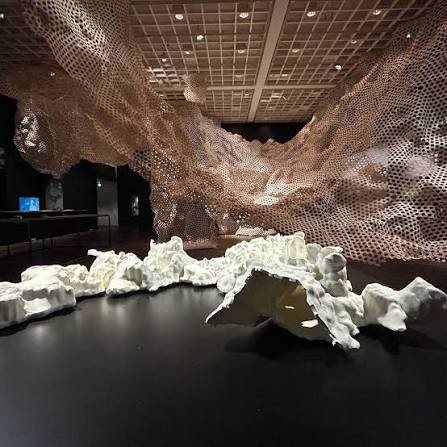
This exhibition program was the largest curatorial iteration of the museum. We were invited to participate in the Sharjah Architecture Triennial (SAT), where we selected a site in the heart of Sharjah, UAE to make an architectural intervention. We chose the old slaughterhouse as an extension of the wider curatorial strategy that works to embed its exhibition programs within the broader fabric of the city. We reflected on this as a form of what we call reverse futurism, where neglected and forgotten parts of the city are reimagined and adapted using a rich cultural exhibition programme to transform the urban and rural grain of the city over time.
In contrast to the purely human centred approach, the museum focused on the primary protagonists of the site being the animals — cows, goats, sheep, and camels — consumed in the city; often without thought of their origins or how they are processed. Visitors to the site are corralled through an ever-present, but seldom reflected upon municipal event space of 3,500 square meters, intermittently used outside the public's consciousness.
On a global scale, man-induced livestock proliferation has constituted the greatest biomass of mammalian life on earth, with animals a commodity that is bought and sold to the highest bidder. In equal and potent measure, human beings have been commodified through capitalism, bought and sold to the highest consumerist bidder. A reference to a recent, near-forgotten past also emerges — enslaved Africans were led from the Indian Ocean shores by Arab merchants to the Middle East, and indeed the Emirates, like livestock.